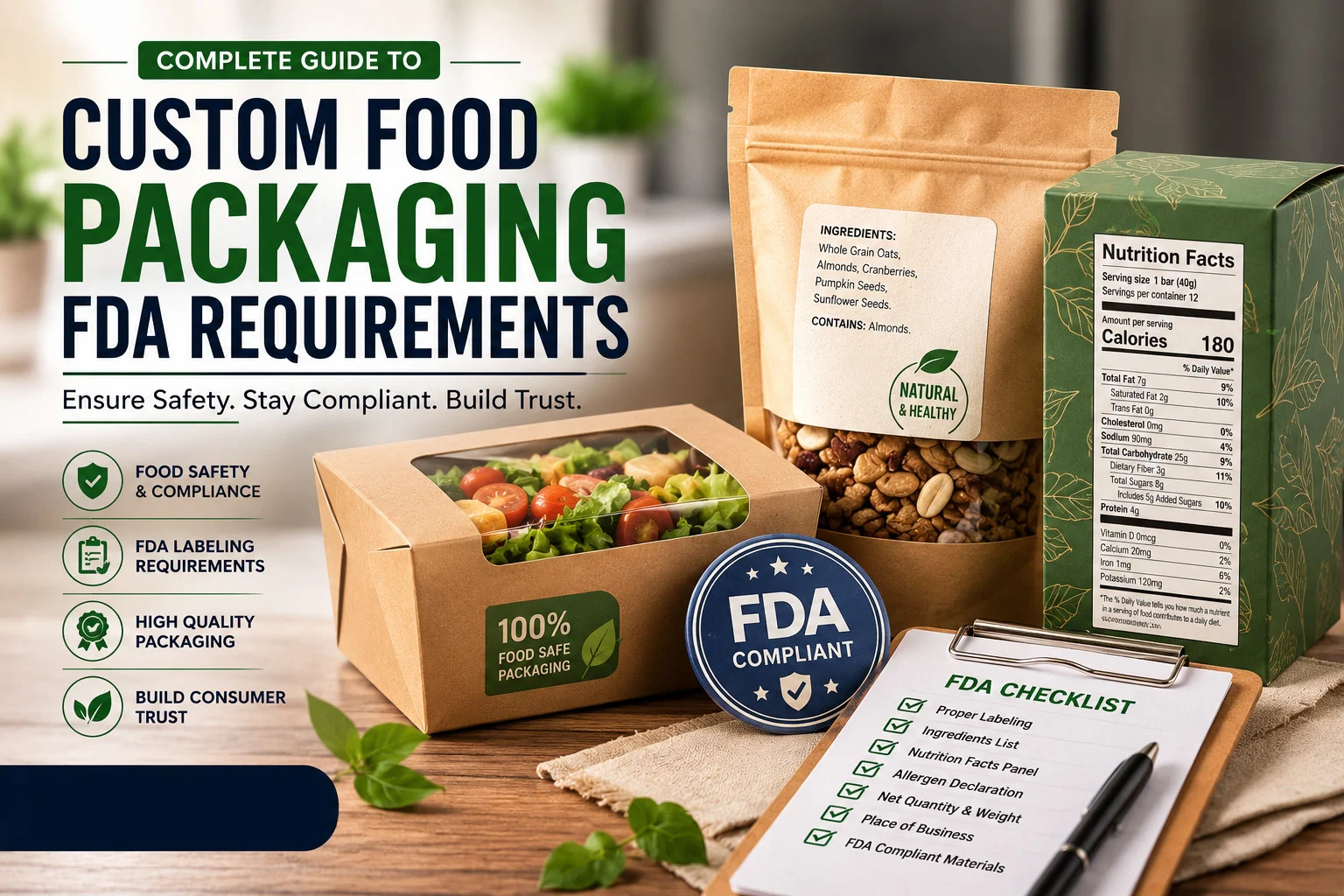
One Missed Label Element Can Cost You Everything
You’ve spent months perfecting your recipe. Your brand identity is locked in. You’ve found a supplier, chosen your box style, and finalized your artwork for your custom food packaging. Then a retailer flags your packaging — or worse, the FDA does — because a single required element is missing from your label.
It happens more than most food entrepreneurs expect. The FDA issues approximately 300 food labeling warning letters annually, and the consequences range from costly recalls to being barred from retail shelves entirely.
The good news: FDA compliance for custom food packaging is not as complicated as it sounds once you understand the framework. This guide breaks down every requirement your food packaging must meet in 2026 — whether you’re a bakery selling artisan cookies, a snack brand launching on Shopify, or an established CPG company scaling to retail.
By the end, you’ll know exactly what to include in your custom food packaging design brief and what to ask your custom box supplier before going to print.
Who This Guide Is For
- Food entrepreneurs and small CPG brands ordering custom packaging for the first time
- Bakeries, snack companies, and specialty food producers selling online or in retail
- Amazon FBA and Shopify sellers shipping packaged food products
- Brand managers reviewing packaging artwork before a product launch
If you’re ordering custom food boxes, mailer boxes, or retail cartons for any food product sold in the United States, this guide applies to you.
How the FDA Regulates Food Packaging
The FDA’s authority over food packaging comes from two primary laws:
The Federal Food, Drug, and Cosmetic Act (FD&C Act) — the foundational law governing food safety in the US, including packaging materials that come into contact with food.
21 CFR Part 101 — the Code of Federal Regulations that specifies exactly what information must appear on food product labels.
These two frameworks cover two distinct but equally important areas: what your packaging is made of, and what it says.
The FDA Does Not Pre-Approve Your Label
This is a critical point that surprises many first-time food business owners: the FDA does not review or approve food labels before you go to market. You are responsible for ensuring your label complies with all applicable regulations before your product hits shelves.
That means the burden is entirely on you — and on your packaging supplier and design team — to get it right.
Food Contact Materials — What Your Box Is Made Of
What Is a Food Contact Substance (FCS)?
Any material that touches your food — or could reasonably be expected to transfer substances to your food — is classified as a Food Contact Substance (FCS) under FDA regulations. This includes:
- The box itself (paperboard, corrugated cardboard, kraft paper)
- Interior coatings and liners
- Printing inks and dyes used on packaging
- Adhesives and glues
- Wax coatings or grease-resistant treatments
The FDA mandates that these categories be safe for consumers. Indirect food additives — including plastics, cardboard, dyes, colorants used for packaging graphics, adhesives, and special substances used to prevent grease from leaking through a package — must be shown to be safe even if trace amounts migrate to the food.
The Migration Testing Standard
Under the FD&C Act, any substance that might migrate into food must be proven safe for its intended use. Supporting this, Title 21 of the Code of Federal Regulations (21 CFR) contains detailed rules about food additives and packaging, including migration testing requirements. These tests simulate the interaction between packaging and food under a variety of conditions, including different temperatures and storage durations.</cite>
In practical terms, this means the cardboard, inks, and coatings used in your custom food boxes must come from an FDA-compliant supplier. When you order custom food packaging from a reputable US-based supplier, this compliance is built into the materials used — but you should always ask for confirmation.
What to Ask Your Custom Packaging Supplier
Before placing your order, confirm the following with your supplier:
- Are your paperboard and corrugated materials compliant with 21 CFR Parts 174–186?
- Are the inks and coatings used food-safe and approved for indirect food contact?
- Do you offer uncoated kraft paper or food-grade liners for direct food contact applications?
- Can you provide a materials compliance declaration if required by a retailer?
A reliable custom packaging partner will have clear answers to all of these questions and documentation available on request.
The 5 Mandatory Label Elements (21 CFR Part 101)
This is where most compliance issues arise. Under 21 CFR 101, every packaged food sold in the United States must display five elements on the Principal Display Panel (PDP) or Information Panel. Missing any one of these is considered misbranding under the Federal Food, Drug, and Cosmetic Act.
Here is each element explained in plain terms.
1. Statement of Identity
This is the common or usual name of your product — what it actually is. It must appear prominently on the principal display panel (the front of your packaging).
Examples:
- “Chocolate Chip Cookies” ✓
- “Artisan Granola” ✓
- “Grandma’s Best” ✗ (brand name alone does not qualify)
The statement must be large enough to be easily read and placed on the PDP in a manner that is clearly visible to the consumer.
2. Net Quantity of Contents
The net quantity of contents is the amount of food in the package, excluding the packaging itself. It must use both metric and US customary units.
For example: “Net Wt 12 oz (340g)”
This statement must be placed in the lower 30% of the principal display panel, in lines generally parallel to the base of the package.
3. Ingredient List
Every ingredient in your product must be listed in descending order of weight — meaning the most predominant ingredient appears first. Sub-ingredients (ingredients within an ingredient) must also be declared.
If your product contains any compound ingredient (like “chocolate chips”), its components must be listed in parentheses.
4. Nutrition Facts Label
FDA food labeling requirements mandate a nutrition facts panel on all packaged food products sold in the United States. The updated Nutrition Facts label format is now mandatory for all manufacturers.
Key updates to the current required format include:
- “Added Sugars” must be listed separately beneath Total Sugars
- Vitamin D and Potassium are now mandatory (replacing Vitamins A and C)
- Serving sizes must reflect amounts people actually eat, not historical reference amounts
- Calories must be displayed in larger, bolder type
Small Business Exemption:If your business has annual food sales under $500,000 and your product sales are under $50,000, you may qualify for an exemption from the Nutrition Facts label requirement. However, if you make any nutrient content claims (such as “low fat” or “high fiber”), you must include nutrition labeling regardless of size.
5. Manufacturer / Distributor Name and Address
The name and address of the manufacturer or distributor must appear on the label. This includes the full business name and a physical US address. A PO Box is not sufficient — a full street address is required.
Allergen Labeling — The 9 Major Allergens
Allergen disclosure is one of the highest-stakes areas of food label compliance, and the rules have evolved in recent years.
Food Allergen Labeling and Consumer Protection Act (FALCPA) of 2004 required declaration of 8 major allergens. The FASTER Act of 2021 added sesame as the 9th, effective January 1, 2023.
The 9 major food allergens that must be declared on US food labels are:
- Milk
- Eggs
- Fish
- Shellfish (crustacean)
- Tree nuts
- Peanuts
- Wheat
- Soybeans
- Sesame
name of the food source of a major food allergen must appear either in parentheses following the name of the ingredient (e.g., “lecithin (soy)”, “flour (wheat)”, “whey (milk)”), or immediately after or next to the list of ingredients in a “Contains” statement (e.g., “Contains: Milk, Wheat, Soy”)
Additional Labeling Considerations for 2026
Front-of-Package Nutrition Labeling
The FDA published proposed front-of-package (FOP) nutrition labeling rules in 2024. While not yet mandatory, early adoption is recommended. The FOP label must highlight calories, saturated fat, sodium, and added sugars using a standardized icon system. Brands that adopt voluntarily gain a 12-month head start on compliance
If you’re designing new packaging in 2026, it’s worth future-proofing your artwork to accommodate an FOP panel — especially if you’re targeting large retail chains, who may begin requiring it proactively.
Natural Color Additives
The FDA is shifting away from petroleum-based food dyes toward natural alternatives and plans to issue guidance on fruit- and vegetable-derived color additives. Brands choosing compliant natural colorings for both their food and their packaging inks will be better positioned for long-term regulatory alignment.
FSMA Traceability Requirements
The FDA Food Safety Modernization Act (FSMA) includes requirements for additional traceability records for certain foods. A proposed extension of the compliance date is under review, but brands in high-risk food categories — including produce, seafood, and ready-to-eat deli items — should ensure their packaging supports lot-level tracking requirements.
Including a lot number or production date on your packaging is best practice regardless of whether your product is on the Food Traceability List.
Industry-Specific Compliance Considerations
Different food categories carry additional label and packaging requirements beyond the standard FDA rules.
Baked Goods and Snack Foods
Standard FDA labeling applies. Pay particular attention to allergen disclosure (wheat, eggs, milk, and tree nuts are common) and ensure your net weight declaration accounts for moisture loss in baked goods if relevant.
Organic Products
Products making organic claims must be certified by a USDA-accredited certifying agent. The certified organic seal, certifier name, and percentage of organic ingredients must appear on the label as specified under the USDA National Organic Program (NOP).
CBD and Hemp Edibles
CBD-infused food products occupy a particularly complex regulatory space in the US. The FDA currently does not permit CBD to be added to food sold in interstate commerce, though enforcement varies by state. If you are selling CBD edibles, consult a food regulatory attorney before finalizing your packaging.
Dietary Supplements
Products marketed as dietary supplements are regulated under DSHEA (Dietary Supplement Health and Education Act), not as conventional foods. They require a Supplement Facts panel rather than a Nutrition Facts panel, and claims on the label are subject to specific restrictions.
Children’s Food Products
If your product is specifically marketed to children under 13, stricter nutrient content claim rules apply. Child-directed packaging cannot make health claims unless the product meets the updated “healthy” nutrient content criteria under the FDA’s December 2024 final rule.
How Custom Packaging Design Intersects With Compliance
Understanding FDA requirements is only half the equation. The other half is translating those requirements into a print-ready artwork file without compromising your brand identity.
Here is how to approach the design process with compliance built in from the start.
Step 1: Map Your Label Zones Before Designing
Before your designer begins, define the following zones on your packaging dieline:
- Principal Display Panel (PDP): Front face — Statement of Identity, Net Weight, brand identity
- Information Panel: Right side of PDP — Nutrition Facts, Ingredient List, Allergen Statement, Manufacturer Info
- Any remaining panels: Best-by date, lot number, UPC barcode, certifications (organic, kosher, etc.)
Defining these zones upfront prevents the common mistake of beautiful packaging that leaves no room for mandatory label elements.
Step 2: Minimum Font Sizes for Legibility
The FDA requires that mandatory label information be legible and conspicuous. While minimum type size requirements vary by element, general best practices include:
- Nutrition Facts panel: minimum 6pt type (8pt preferred)
- Ingredient list and allergen statement: minimum 6pt type
- Net weight: type size determined by PDP area (see 21 CFR 101.105 for the formula)
- Statement of Identity: must be prominent — typically 1/2 the size of the largest type on the PDP
Step 3: Provide Print-Ready Files With the Correct Color Profile
Food packaging is printed in CMYK, not RGB. Colors that look vivid on screen can shift significantly in print, particularly with kraft paper stock. Request a physical proof before approving full production — this is especially important for any legally required elements like the Nutrition Facts panel, where legibility is a compliance issue, not just an aesthetic one.
Step 4: Review Artwork Against a Compliance Checklist
Before submitting final artwork to your printer, review every panel against the following checklist:
Principal Display Panel:
- [ ] Statement of identity present and prominent
- [ ] Net quantity of contents in lower 30% of panel
- [ ] Both metric and US customary units included
Information Panel:
- [ ] Nutrition Facts label in required format (updated 2020 format)
- [ ] Added Sugars declared separately
- [ ] Vitamin D and Potassium included
- [ ] Complete ingredient list in descending weight order
- [ ] All 9 major allergens declared (if applicable)
- [ ] “Contains” statement or parenthetical allergen disclosure consistent
Other Required Elements:
- [ ] Full manufacturer/distributor name and physical address
- [ ] Lot number or production date (recommended)
- [ ] UPC barcode
- [ ] Any required certifications (organic, kosher, etc.)
Choosing an FDA-Compliant Custom Food Packaging Supplier
Not all custom box suppliers are created equal when it comes to food packaging. Here is what to look for when evaluating a supplier for custom food boxes.
FDA-compliant materials: Your supplier should be able to confirm that all materials — paperboard, inks, coatings — are food-safe and compliant with 21 CFR Parts 174–186 for the intended use case.
Food-grade liner options: If your product is in direct or semi-direct contact with the packaging interior, ask about food-grade liner or insert options.
Experienced dieline team: A supplier with food packaging experience will understand label zone placement, bleed requirements, and print tolerances — reducing the risk of compliance errors in the final output.
Low minimum order quantities: For smaller food brands or seasonal product launches, the ability to order 100–500 boxes without a $10,000 minimum order is essential. Digital printing technology has made short-run custom food boxes economically viable without sacrificing print quality.
No die and plate charges: Traditional printing methods charge setup fees for each new design. Suppliers offering no die and plate charges make label updates — necessary when reformulating products or meeting new FDA requirements — far less costly.
Free structural samples: Before committing to a full run, request structural samples to verify sizing, material thickness, and any food-safe inner coatings.
Does the FDA inspect every food package?
The FDA does not inspect every individual package. Instead, it regulates the components that make up food packaging. Any packaging material that comes into contact with food is subject to regulation as a food contact substance. Compliance is the responsibility of the manufacturer and brand owner.
Do I need a Nutrition Facts label if I sell from a farmers market or local bakery?
Certain exemptions apply to small businesses and products sold directly to consumers from the place of manufacture. However, once your product is sold through third-party retailers, online platforms, or interstate, FDA labeling requirements apply in full. Consult the FDA’s small business exemption guidelines (21 CFR 101.9(j)) to determine your specific situation.
Can I use the same packaging design for Canada and the USA?
No. Canadian food labeling is regulated by Health Canada and the Canadian Food Inspection Agency (CFIA), with different requirements including bilingual English and French labeling. Your FDA-compliant US packaging will not automatically meet Canadian requirements.
What happens if my label is non-compliant?
Consequences range from FDA warning letters to mandatory product recalls, import detentions, and in serious cases, criminal prosecution. Retailers may also remove non-compliant products from shelves independently of any FDA action. Prevention through proper design review is always less expensive than remediation
How long does it take to get custom food packaging printed?
Production timelines vary by supplier and order size. Typical lead times for custom food boxes range from 10–20 business days after artwork approval. Rush options are available from some suppliers for time-sensitive launches. Always build in time for a physical proof review before approving full production.
Conclusion: Compliance Is a Competitive Advantage
FDA compliance in custom food packaging is not just a legal obligation — it’s a brand asset. Consumers and retailers alike interpret clean, complete, professionally printed packaging as a signal of a trustworthy food brand. Conversely, a label that looks incomplete or incorrect erodes confidence regardless of how good the product inside is.
The practical steps are clear: understand which materials regulations apply to your packaging, include all five mandatory label elements under 21 CFR Part 101, declare all nine major allergens accurately, and work with a packaging supplier who has experience in the food industry.
Getting this right from the start — before your first print run — is significantly less expensive than fixing it after the fact. A well-briefed custom packaging partner will help you navigate both the compliance requirements and the design process, so your packaging works as hard as your product does.
About Nova Custom Boxes
Nova Custom Boxes is a USA-based custom packaging company serving food brands, bakeries, snack companies, and CPG businesses across the country. We offer FDA-compliant food-safe packaging materials, no die and plate charges, low minimum order quantities starting from 100 boxes, and free shipping on all orders. Get a free quote today →